
Interrupt
during reasoningA dialog, an error or a new page appears while the agent is still reasoning about the old screen. NightWatch cancels the generation, and the agent re-plans on the current screen.

1National University of Singapore 2A*STAR Centre for Frontier AI Research (A*STAR CFAR) 3SenseTime 4Hong Kong Baptist University
 0.8B Jev-style System-1 watcher
Plug-in for any CUA · Hermes Agent plugin soon
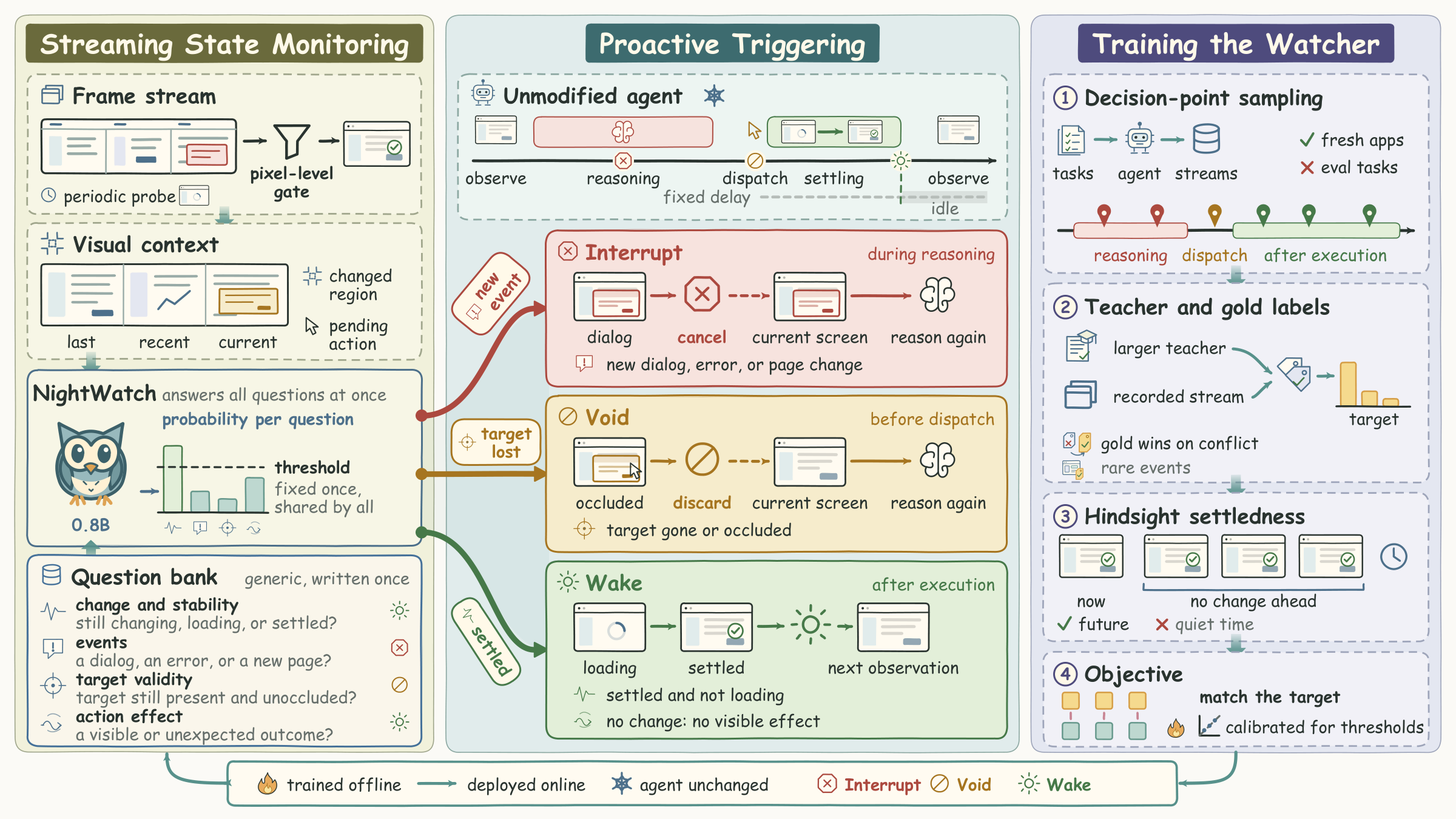
Computer-use agents look at the screen on their own clock: take a screenshot, reason, act, sleep for a fixed delay, repeat. On a live screen this goes wrong both ways. The agent reasons about a screen that has already changed, and it sleeps through a page that loaded long ago. NightWatch lets the screen decide when the agent looks. A 0.8B watcher reads the screen as a stream and, through three fixed rules, interrupts reasoning that a change has made obsolete, voids a click whose target is gone, and wakes the agent the moment the screen settles. The agent itself is not modified.
A dialog, an error or a new page appears while the agent is still reasoning about the old screen. NightWatch cancels the generation, and the agent re-plans on the current screen.

The element the agent chose to click has moved, been covered, or disappeared. NightWatch discards the action before it lands, instead of letting it hit the wrong target.
The fixed sleep after each action is replaced: NightWatch wakes the agent as soon as the screen has settled, learned from hindsight labels rather than from stillness alone.
Each video shows four real episodes side by side, with the same agent (MiMo-V2.6-Flash), prompt, action space and step budget. Each panel shows the agent's state and its intervention log, with a timeline coloured by what the loop was doing. Playback slows to 1× around NightWatch's interventions. The closing card reports the episode times and each method's success over the three paper runs of that task.
OSWorld-Verified · “Run ls in /home/user and save a screenshot of the terminal as
ls.png on the Desktop.”
The Files window finished opening while the agent was still reasoning about the half-drawn screen. NightWatch cancelled that reasoning, and the agent re-planned on the current screen and finished in 7 steps. Over the three paper runs: NightWatch 3/3, Vanilla 1/3, AOI 0/3, PUSV 1/3.
Paper runs, run 2 of 3. Screenshot replay: each frame is a screenshot the agent received, shown at its logged time (OSWorld runs were not screen-recorded).
DynaCU-Bench · “Click the matching color swatch when it appears among rotating options.”
The swatches rotate while the agent reasons. Twice, the swatch the agent chose had already moved when the click was due: NightWatch voided the click instead of hitting the wrong colour, and the agent re-planned on the current screen. Over the three paper runs: NightWatch 3/3, Vanilla 3/3, AOI 2/3, PUSV 2/3.
Continuous screen recordings. NightWatch: paper configuration, episode chosen to show the intervention; baselines: the first demo recording of each method.
DynaCU-Bench · “Three servers will go critical at different times. Acknowledge each within 5 seconds of it going red.”
When the next server turned red while the agent was still reasoning about the old screen, NightWatch cancelled that reasoning at once, so the agent saw the new alarm in time. Over the three paper runs of this task: NightWatch 3/3, Vanilla 2/3, AOI 1/3, PUSV 1/3.
Continuous screen recordings from one demo session with the paper configuration; the first recording of each method.
OSWorld-Verified · “Browse list of Civil Division forms.”
All four agents solve this run. The agent writes sleeps into its own actions while pages load; NightWatch strips them and wakes the agent as soon as the screen settles. Outside reasoning, a step costs 4.1 s with NightWatch against 15.1 s (Vanilla), 9.4 s (AOI) and 14.3 s (PUSV); NightWatch finishes in 193 s.
Paper runs, run 3 of 3. Screenshot replay: each frame is a screenshot the agent received, shown at its logged time.
NightWatch splits the work between two models that run at different speeds, like System 2 and System 1.
A large vision-language model (MiMo-V2.6-Flash, Qwen3.8-27B, ...) plans and acts. It is slow: one step takes seconds of reasoning, and it sees the screen only through the screenshots it asks for. NightWatch does not change it: same model, prompt and action space.
NightWatch-0.8B is a Jev-style System-1 decision model. It reads the latest frames and the pending action once and returns a probability for every question of a fixed bank (has a dialog appeared, is the target still there, has the screen settled), without generating text, so it can keep up with the screen.
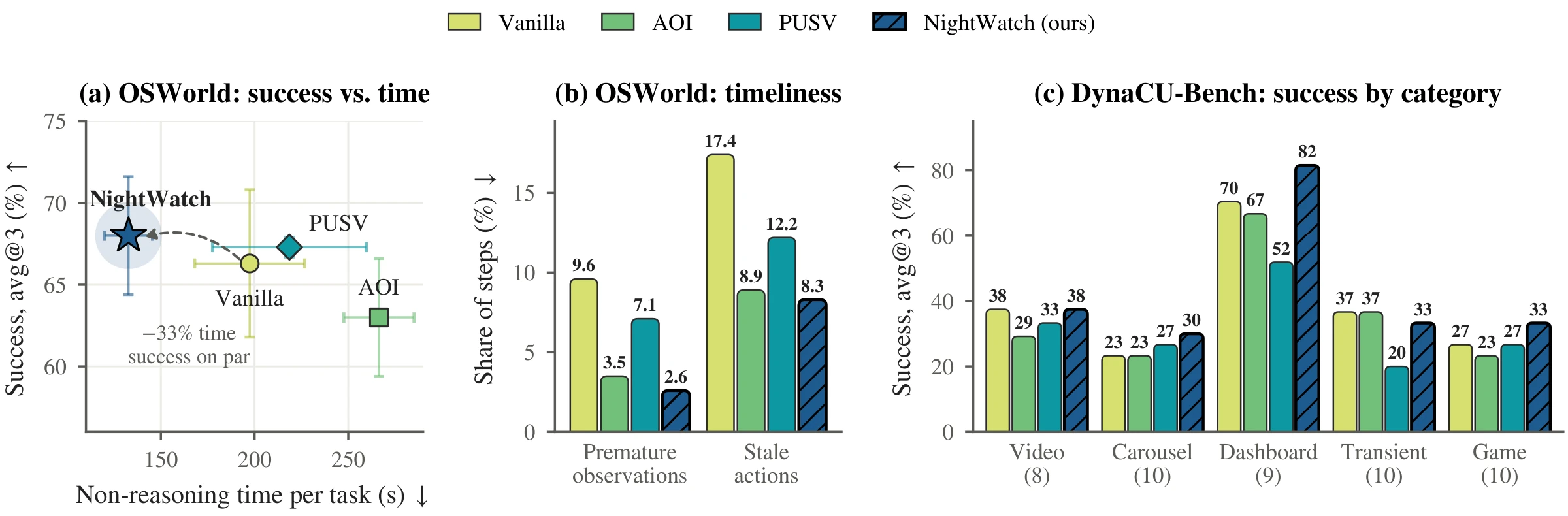
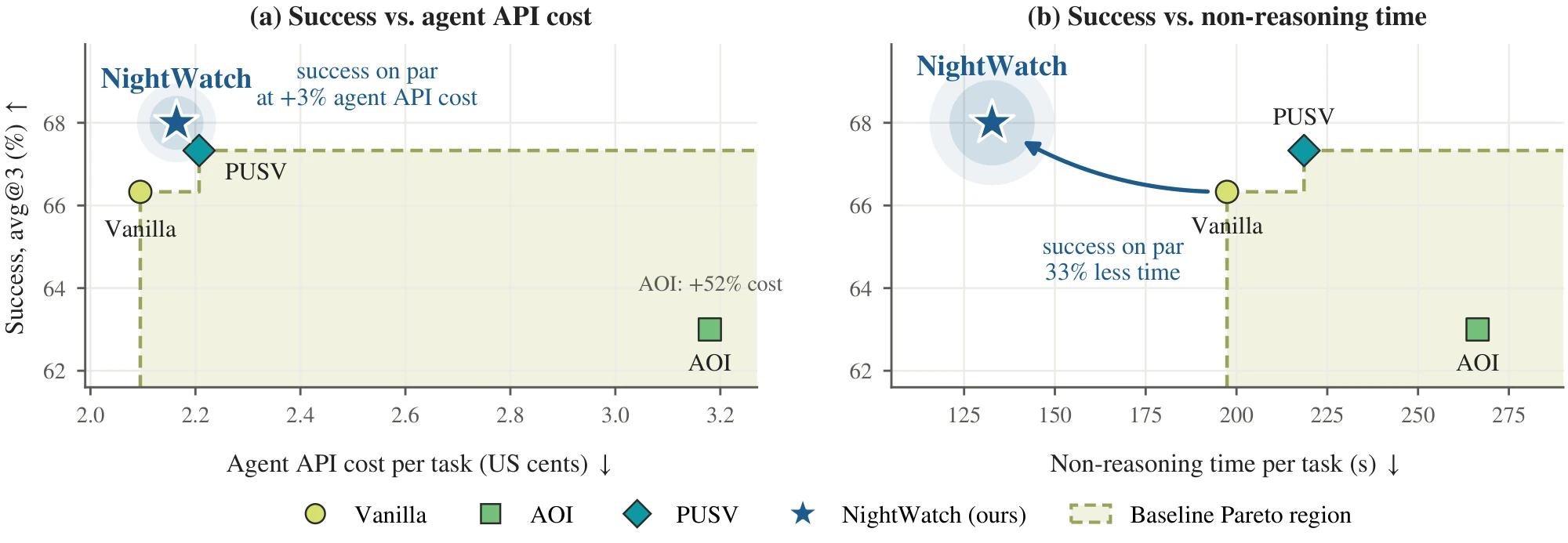
How they work together. The watcher never chooses what the agent does; it only decides when the agent should look and whether its current thought or action still holds. Fixed thresholds turn its answers into the three interventions: interrupt the agent's reasoning when the screen changes under it, void an action whose target has gone, and wake the agent as soon as the screen has settled. The small model keeps the large one in sync with the screen at a fraction of its cost: in the paper's ablation, the 0.8B watcher is faster and more successful than a hosted Jev API watcher and than a System-1 decision model more than 30× its size.
GUI agents perceive the screen through discrete screenshots on their own clock, so they reason about screens that have already changed (stale actions) and sleep through screens that are ready (idle waiting). NightWatch lets the screen decide when the agent looks.
No. NightWatch sits in the harness: it cancels the agent's model call, drops a pending action, or ends a wait. The agent's model, prompt and action space stay unchanged.
NightWatch-0.8B is a Jev-style System-1 decision model: like Jev, it answers a set of typed questions with probabilities in a single pass instead of generating text, which is what makes watching every frame cheap. In the paper it is compared with the hosted Jev API used as the watcher.
OSWorld-Verified (100 tasks, 3 runs) and DynaCU-Bench (49 dynamic web tasks, 3 runs), with MiMo-V2.6-Flash and Qwen3.8-27B agents, against Vanilla, AOI and PUSV under the same screenshot-only input.
The code and the 0.8B watcher are open (Apache-2.0). A plugin for Hermes Agent's computer use is in preparation.
@misc{su2026dontsleepwatchproactive,
  title         = {Don't Sleep, Keep Watch: Proactive Perception for Computer-Use Agents},
  author        = {Jiaqi Su and Jie-Jing Shao and Yichen Liu and Long-Kai Huang and Haiyan Yin},
  year          = {2026},
  eprint        = {2611.28947},
  archivePrefix = {arXiv},
  primaryClass  = {cs.CL},
  url           = {https://arxiv.org/abs/2611.28947}
}